Leadership Between School Years: The Transition Season of Student Transportation
Each spring, school transportation departments enter one of the most consequential planning periods of the year.
Field trips fill the calendar. Athletic programs expand. Drivers are covering regular assignments, substitutes are filling the gaps, and dispatch is responding to morning challenges. Daily service continues without pause, while everyone in the organization has their eyes on the last day of school.
At the same time, however, quieter shifts are already underway.
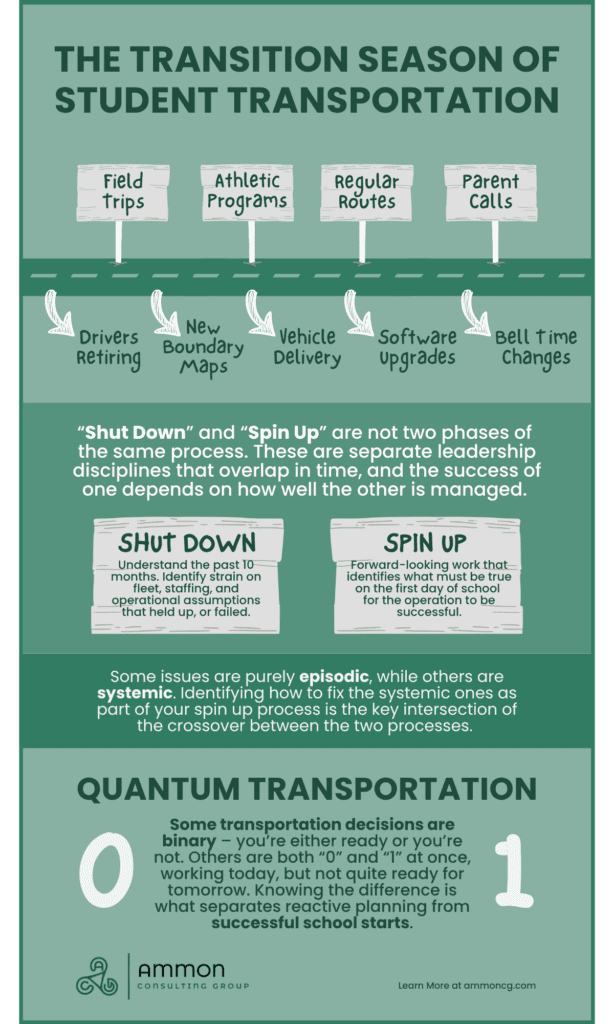
Two veteran drivers have submitted retirement paperwork. A new elementary school boundary map has just been approved for the fall. Three replacement buses are scheduled for delivery, but the timing is uncertain. A routing software upgrade is expected over the summer, and the district is considering bell time adjustments that could affect tiering efficiency.
None of these changes disrupt service today. But organizations that treat these developments as “summer planning items” often find themselves making compressed decisions later when fewer options remain, while organizations that begin addressing them now create flexibility that carries success into the next year.
The challenge for transportation leaders is recognizing that “shut down” and “spin up” are not two phases of the same process; they are separate leadership disciplines that happen to overlap in time, and the success of one depends on how well the other is managed.
Shut Down and Spin Up Are Not Bookends
It’s natural to think of the end of the school year as a sequence: operations wrap up, you evaluate what happened, take a break for the 4th of July, and start anew preparing for the next year.
Semantics even suggests that you should start with shut down and proceed to spin up. But that is exactly the wrong way to think about it, as the goals of the two processes are very different.
- Shut down is about understanding what the past ten months have done to the operation. It’s a period for identifying strain on the fleet, any staffing patterns that shifted during the year, and operational assumptions that held up (or that didn’t).
- Spin up is about something else entirely. It’s forward-looking work that prepares the transportation department for the challenges ahead, and any changes already coming into view: new students, new bell times, new routing schedules, new schools, new technology expectations, and new staffing realities.
This distinction matters because the driving constraint with the spin up process is timing, and planning must begin early enough to accommodate lengthy lead-time decisions – while data analysis of the shut down process continues alongside it to sharpen those decisions as informational value from the current year becomes clearer.
For your staff, understanding the crossover may require some cognitive gymnastics. So the challenge for transportation leaders becomes making the distinction between the two visible, and manageable.
Spin Up Begins Earlier Than You Think
Transportation staff may be accustomed to thinking about next year’s routing changes and student ridership as the beginning of preparations for the fall. In reality, those are only the most visible parts of the process.
Driver availability, for example, is rarely solved in July. Recruitment pipelines, training schedules, and licensing progress all require decisions months earlier. Fleet planning happens on an even longer horizon. Vehicle replacements, delivery timing, bus size decisions, and possible maintenance backlog all shape what routing is possible, long before routing drafts are submitted.
Technology implementation follows a similar pattern – data integrations, scheduling tools, communications platforms, and safety systems only truly improve operations when they are introduced early enough to influence planning, rather than layered on afterward.
Effective spin up planning begins with identifying what must be true on the first day of school for the operation to be successful. From there, leaders can work backward to determine when each prerequisite decision needs to occur.
For these types of concerns, if you haven’t started yet there is no time like the present! This approach shifts planning from reacting to fall constraints, to shaping them.
Shut Down is For Data Gathering
If spin up planning is about preparing the operation for what comes next, the goal of a reliable shut down process must be to understand how the operation performed over the prior 10 months, and where improvements are needed. Some issues are purely episodic, while others are systemic – and identifying how to fix the systemic ones as part of your spin up process is the key intersection of the crossover between the two processes.
A good shut down analysis should establish insight across four essential dimensions of pupil transportation performance:
RELIABILITY. Measuring on-time performance, and understanding why the service performed below or above expectations, reveals whether scheduling assumptions matched operational realities.
AVAILABILITY. The ongoing driver shortages, substitute coverage gaps, and the challenges of fleet readiness all leave behind measurable patterns. Being able to identify when and where availability constraints impacted service helps leaders distinguish between short-term disruptions and structural vulnerabilities.
SAFETY. Incident reviews are an expected (and critical) part of transportation oversight, but the most valuable safety data comes from examining the near misses. Understanding why problems almost occurred – and why, ultimately, they did not – provides one of the most powerful opportunities for improving system performance before the next year begins.
EFFICIENCY. Comparing projected and actual resource use can determine whether the system performed as designed, or whether it adapted under pressure in ways that should be incorporated into future planning.
Quantum Transportation
Some transportation decisions are binary – you’re either ready or you’re not. Others are both “0” and “1” at once, working today, but not quite ready for tomorrow. Knowing the difference is what separates reactive planning from successful school starts.
Without clear structure, teams will often default to the timeline that feels more urgent (the one happening today) and as a result, forward planning gets compressed into a timeline where flexibility and options are limited.
Preventing that compression is one of the most critical responsibilities of transportation leaders. And they can achieve this by making the crossover period visible to staff, separating responsibilities across timelines, and helping staff recognize how insights from one process should influence decisions in the other.
The work of student transportation never truly stops. The end of the school year is simply the beginning of the next cycle, and the success of one depends on how well the other is managed.